Showing posts with label Interactive Display. Show all posts

Monday, July 18, 2016

Nadab & Abihu


Central Truth: We must honor God by obeying his commands.

Scriptures: Leviticus 10:1-11

When God gave Moses the laws and the pattern for the Tabernacle, he also gave him instructions for establishing the priesthood. Aaron was appointed as High Priest and his sons and their descendants were given the responsibility for the priesthood. All other Levites were in charge of the Tabernacle and its furnishings. The priests were anointed by God.

Nadab and Abihu were the sons of Aaron. They put fire and incense in their censor and offered before the God, but it was strange fire which God did not command. As a result, God devoured Nadab and Abihu with fire and they died. God told Moses that those who came before him must be holy or they cannot come near.

Interactive Display
To help the story to come alive for the children, I put together an interactive display for the story of Moses. Each week, something new is either revealed or added or taken away. This time, I took away two of Aaron's sons from the Tabernacle complex and discussed the Priestly garments.


We also had a little fun playing jeopardy:


Sunday, July 3, 2016

The Tabernacle


Central Truth: God wants to dwell among his people.

Scriptures: Exodus 25-30

When Moses was on Mount Sinai, God gave him many laws in addition to the Ten Commandments and instructions for building a Tabernacle (a place for worship). The Tabernacle was to be a temporary place for the Israelites to worship during their wanderings through the wilderness and the early years of their time in the Promised Land. The Tabernacle included a courtyard constructed with boards that could easily be taken apart for transportation. The boards were covered with animal skins and curtains. The furniture for the Tabernacle was also portable. Eventually, the Tabernacle was replaced by the magnificent Temple built by King Solomon many centuries later.


The Outer Court
The Outer Court was the area within the fenced courtyard and can only be accessed from one gate located at the eastern end. Anyone could enter the courtyard. It contained a bronze altar for sacrifices and a bronze laver where the priests washed their hands and feet before entering the tent of Tabernacle.

The Outer Court with the Bronze Altar at the entrance followed by the Bronze Laver.
The Holy Place
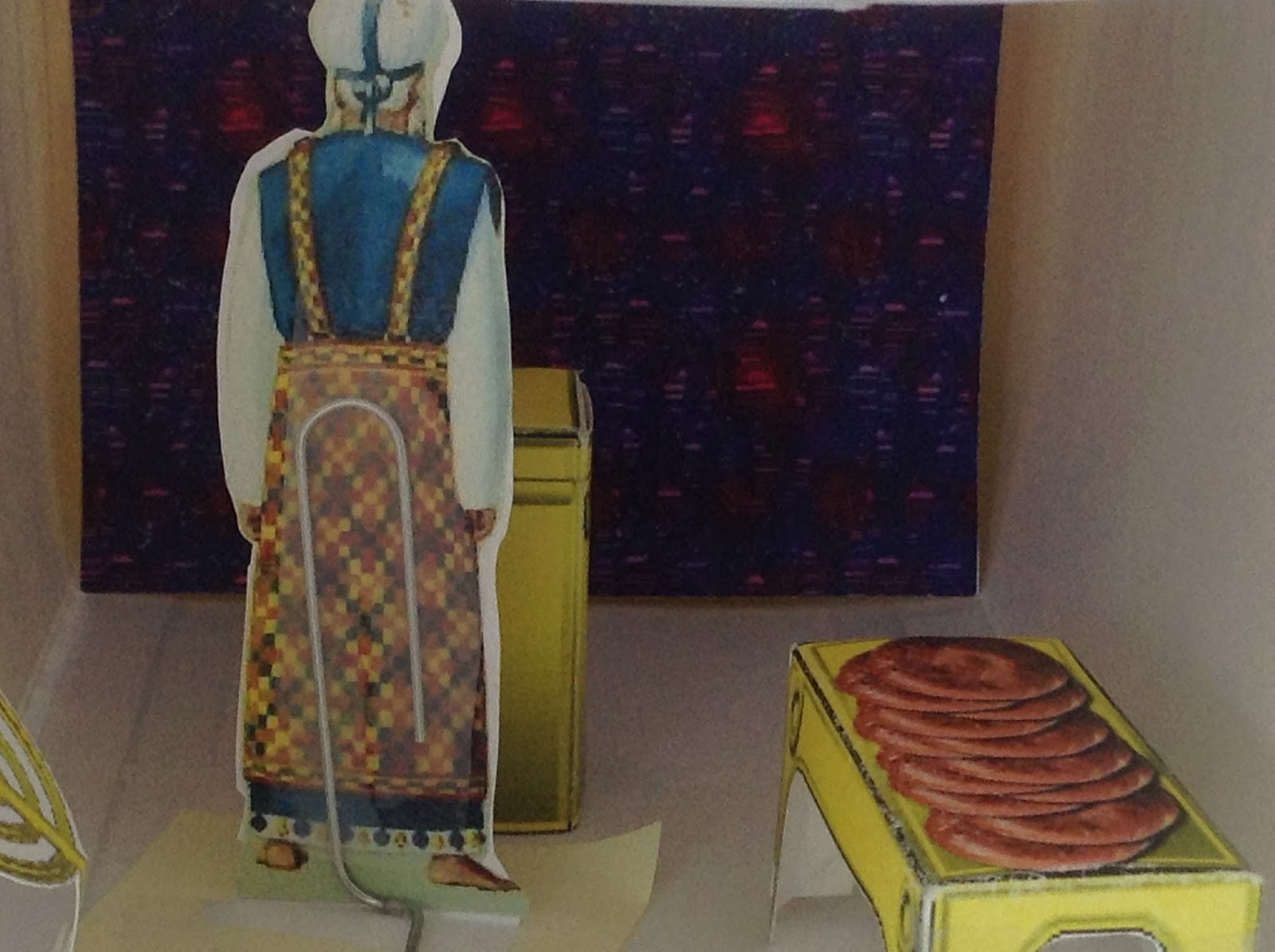
The tent of Tabernacle had two sections. The first section was the Holy Place where only the priests were allowed to enter. Inside the Holy Place was the Menorah, the Table of Shewbread, and the Altar of Incense. 

The Menorah was lit from dusk to dawn with fire from the Brazen Altar and provided light for the priests in the Holy Place. It symbolized how the Holy Spirit illuminates our understanding of the things of God.

The High Priest before the Menorah in the Holy Place within the Tabernacle.
The Table of Shewbread was a golden plated table with twelve loaves of bread, representing the twelve tribes of Israel. The bread was left on the table for seven days and sprinkled with incense before eaten by the priest's family. The shewbread represented Jesus as the Bread of Life.

The Altar of Incense was located directly in front of the veil that divided the Holy Place and the Holy of Holies. At morning and at twilight the priests burned incense with fire from the Brazen Altar. The priests would pray for the people before the altar.

The Holy Place with the Table of Shewbread and the High Priest before the Altar of Incense.
Holy of Holies
The second of the tent of Tabernacle was the Holy of Holies and was the most sacred part of the Tabernacle. Within this room was only one piece of furniture, the Ark of the Covenant.  Inside the Ark of the Covenant were the tablets with the Ten Commandments, a golden pot filled with manna, and Aaron's Rod that budded - all items of rebellion and symbolizes God's delivering power. 

Inside the Ark of the Covenant

Interactive Display
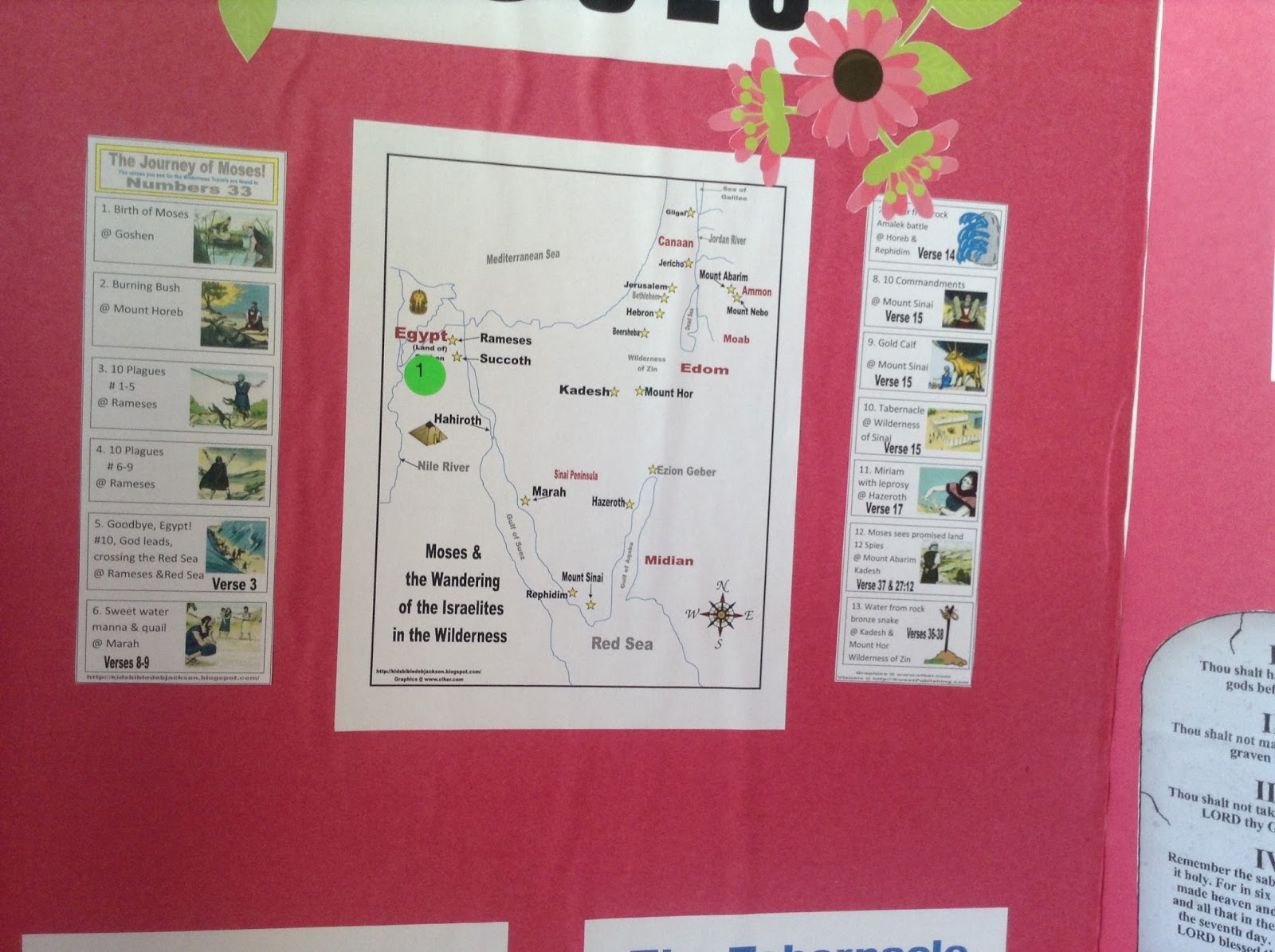
To help the story to come alive for the children, I put together an interactive display for the story of Moses. Each week, something new is either revealed or added or taken away. Today the children got a thorough look at the Tabernacle and its furniture and how they all point to Jesus. When God gave Moses the plans for creating the Tabernacle with its sacred objects, the Israelites were still camped at Mount Sinai. A year to the day that they left Egypt, the Tabernacle was completed and the cloud of God rested in the Holy of Holies. When God wanted the Israelites to move their camp, the cloud withdrew and was a flaming fire that led them to their next destination. With the number 10, the children marked the location where the Tabernacle was created at Mount Sinai:

Interactive map of the Wandering of the Israelites in the Wilderness.

Sunday, June 19, 2016

The Golden Calf

Destinee's coloring page of Psalms 121:1-2.
Central Truth: We must always be patient and wait upon the Lord.

Scriptures: Exodus 24:12-18; 31:18; 32

When God gave Moses the Ten Commandments, he did so within their hearing. When the people saw the thunder, lightning, the sound of the trumpet, and the smoking mountain, they were afraid. They told Moses that he should go to speak to God so they would not die. Moses then went up the mountain to receive the law and the commandments. 

Moses was on Mount Sinai talking to God for forty days and forty nights. When Moses returned to the Israelite camp, he discovered that they committed a great sin. In his absence, they convinced Aaron to fashion a golden calf to worship as the god who brought them out of Egypt. Aaron took their earrings and melted the gold to create the golden calf. God was so angry, he wanted to destroy all of the people, but Moses pleaded with God to spare their lives by reminding God of his covenant with Abraham, Isaac, and Jacob. When Moses saw with his own eyes what the people had done, he was angry and broke the tables of stone that God had written the Ten Commandments. He then melted the calf down, grounded it into powder, and made the people drink it. 

Interactive Display
To help the story to come alive for the children, I put together an interactive display for the story of Moses. Each week, something new is either revealed or added or taken away. Today we marked the location of where the children of Israel sinned by worshiping the Golden Calf (number 9 on the map):

Lots of action happening at Mount Sinai on the map!


Sunday, June 12, 2016

The Ten Commandments

Central Truth: God cares about our relationships.

Scriptures: Exodus 19; 20:1-21

After the battle with the Amalekites, Moses led the Israelites to Mount Sinai where they made camp. God called to Moses from the mountain and instructed him to prepare the people to receive the laws and covenant. God promised that as long as they kept his covenant, then they will be a "kingdom of priests, and an holy nation" (Exodus 19:6). Moses told the people to wash their clothes and purify themselves for two days. On the third day, the Lord came down on Mount Sinai in a thick cloud and fire and gave Moses the Ten Commandments within the hearing of all the people.

The Ten Commandments


1. Thou shalt have no other gods before me.
2. Thou shalt not make unto thee any graven image.
3. Thou shalt not take the name of the Lord thy God in vain.
4. Remember the Sabbath Day and keep it holy.
5. Honor your father and your mother.
6. Thou shalt not kill.
7. Thou shalt not commit adultery.
8. Thou shalt not steal.
9. Thou shalt not bear false witness against thy neighbor.
10. Thou shalt not covet.

Interactive Display
To help the story to come alive for the children, I put together an interactive display for the story of Moses. Each week, something new is either revealed or added or taken away.  After traveling for three months, the Israelites make it to Mount Sinai where the laws and covenant were given to them. Mount Sinai is marked with a number 8 on the map:


Sunday, June 5, 2016

Rephidim


Battle with the Amalekites (picture from freebibleimages.org).

Central Truth: The Lord is our banner.

Scriptures: Exodus 17

The children of Israel continued their journey through the wilderness of Sin to Rephidim where there was no water to drink. The Israelites complained to Moses who prayed to God. The Lord told him to take his rod and strike a rock. Moses obeyed and water came out of the rock for the people to drink.

Then the Israelites faced their first enemy since the destruction of Pharaoh's army at the crossing of the Red Sea. As they traveled through the wilderness, they were attacked by the Amalekites who were descendants of Esau, the twin brother of Jacob's. Moses appointed Joshua to be commander over the Israelite army and face the Amalekites in battle. Moses watched the battle from a nearby hill with his brother Aaron and Hur. As long as Moses held his hands up to God, the Israelites prevailed in battle but, when his arms grew tired and he lowered them, the Amalekites prevailed. Moses then sat upon a stone while Aaron and Hur held up his arms, one on either side of him, until the sun set. As a result, the Israelites defeated the Amalekites.


Interactive Display
To help the story to come alive for the children, I put together an interactive display for the story of Moses. Each week, something new is either revealed or added or taken away. This week, we traveled from Marah to Rephidim located near the tip of the Sinai Peninsula (marked with the number 7 on the map).

Rephidim and the battle with the Amalekites on the map.

Sunday, May 29, 2016

Quails and Manna


Central Truth: God cares for his people and provides for their needs.

Scriptures: Exodus 15:22-27; 16

After they crossed the Red Sea, the Israelites continued into the Sinai Peninsula. As they traveled into the wilderness of Shur they only found water that was so bitter they could not drink it. The people complained and murmured against Moses. God told Moses to cast a tree into the water, and the water became sweet. God made a covenant with the people, promising to protect them from the diseases he brought upon the Egyptians if they obeyed him.

When they traveled into the wilderness of Sin, they became hungry and again complained and murmured against Moses. They told Moses and Aaron that they should have stayed in Egypt where they had plenty of food. God saw their needs and sent quails in the evening and rain bread from heavin in the mornings. Each morning the people gathered a daily portion for each person in their household. They were to gather enough for one day. Any bread remaining would spoil the next day. On the sixth day, they were to gather twice as much because the people were to observe the sabbath day. Miraculously, the extra portion did not spoil overnight and no bread was to be found on the seventh day. God instructed Moses and Aaron to put a measure of manna in a pot and to keep it as a memorial for future generations.

A measure of manna ready to be placed into the Ark of the Covenant.

As we talked about the manna, the children got to try some honey crackers that simulated what the manna may have tasted like. I found the recipe on Pinterest along with several others that will be fun to try.


Interactive Display

To help the story to come alive for the children, I put together an interactive display for the story of Moses. Each week, something new is either revealed or added or taken away.  


This week's lesson took the children on a journey from the Red Sea through the wilderness. We pointed out all of the major geographic features prominent within our story and marked with the assumed location of Marah (#6 on the map) where God made the bitter waters sweet by having Moses throw a tree into the water. 

Interactive map of Egypt and the Sinai Peninsula.
Over the last few weeks, we have been watching segments the Ten Commandments, which can be found on YouTube


Monday, May 23, 2016

Crossing the Red Sea


Central Truth: The Lord will always triumph gloriously.

Scriptures: Exodus 12:37-51; 13:17-22; 14

After the tenth plague, the death of the firstborn, there was a great cry in the land for there was not a house where there was not one dead. The Egyptians wanted the Israelites to leave. Pharaoh told Moses and Aaron to take the Israelites with their flocks and herds and go. Before they left, the Egyptians gave the Israelites silver, gold, and clothing. When the Israelites left, they left with great wealth.

Exodus 3:8 coloring page.

They started their journey from the land of Goshen with a stop at Ramses. About 600,000 men with their families left Succoth, moving towards the Red Sea. Again, Pharaoh's heart hardened. He pursued after the Israelites and cornered them at the Red Sea. There was no escape, but God performed a great miracle. God parted the waters of the Red Sea and the Israelites escaped across on dry land. When the Egyptian army followed, God released the waters and drowned the pursuing army.


Interactive Display
To help the story to come alive for the children, I put together an interactive display for the story of Moses. Each week, something new is either revealed or added or taken away. This week we added a diorama of the Red Sea using cute little paper people I found on My Little House.


Sunday, May 15, 2016

The First Passover

Homemade unleavened bread.
Central Truth: God always makes a way of escape.


Scriptures: Exodus 7:14-25; 8-12:1-36 

After enduring nine plagues, Moses announced that a final plague will hit Egypt. At midnight, the Lord will go out into the midst of Egypt. All of the firstborn sons in the land will die, from the firstborn of the pharaoh to the firstborn of the animals. In God's mercy, the Israelites were able to escape the plague by dipping hyssop in blood and smearing the blood upon the doorposts of their houses. Those within the house will escape the destroyer as long as they stayed inside until morning.

During the night, the Israelites had the first Passover meal. They roasted a lamb without spot or blemish and ate it along with bitter herbs. They removed all of the leaven in their homes and at unleavened bread that night and for seven more days known as the Feast of Unleavened Bread. They were to prepare the food and be ready to leave in haste with their staff in hand. 

Interactive Display

To help the story to come alive for the children, I put together an interactive display for the story of Moses. Each week something new is either revealed or added or taken away. This week we marked on the map the last plague and the location of the first Passover (marked with the number 5).

Getting ready to leave Egypt!
For the first time, we got to remove an item from the display to make room for next week's lesson. What is Passover? is a booklet that highlights the events that led to the first Passover, beginning with the story of Joseph and ending with the first Passover. The booklet can be found free online by the International Fellowship of Christians and Jews.


Finally, we uncovered the last flap on the plagues flapbook, the plague of the death of the firstborn sons and animals.

The Ten Plagues flapbook.

Sunday, May 8, 2016

The Plagues of Egypt

Moses and Aaron meet with the pharaoh (image from freebibleimages.org).

Central Truth: God will fight for his people and fulfill his promises.

Scriptures: Exodus 7:14-25; 8-10

To prove to the pharaoh and the Egyptians that the God of Israel was greater than the gods of Egypt, Moses and Aaron demonstrated God's power with ten plagues upon the people and the land of Egypt. With each plague, God showed his power and defeated the Egyptian gods. 

Interactive Display

To help the story to come alive for the children, I put together an interactive display for the story of Moses. Each week, something new is either revealed or added or taken away. Today, we revealed the nine of the plagues of Egypt.

The Ten Plagues flapbook (from Tina's Dynamic Homeschool Plus).

We also marked on the map where the plagues occurred in Egypt (marked with #3 and #4 on the map below).

Life of Moses map.
During freetime, the children enjoyed some wonderful handouts and visuals about the plagues of Egypt that can be found at http://www.biblepathwayadventures.com/ and http://homeschooling.about.com/od/holidays/ss/passoverprint.htm.

Sunday, May 1, 2016

Moses Meets with Pharaoh

Image from freebibleimages.org

Central Truth: Be patient and wait on the Lord.

Scriptures: Exodus 5, 7:1-13

After God spoke to Moses, Aaron met Moses in the mountains and together they returned to Egypt. They gathered the elders of the children of Israel and told them of how God appeared to Moses and did all the signs that God commanded him to do. The people believed and worshiped God. Moses and Aaron then appeared before the pharaoh and told him to release the Hebrews to travel three days into the wilderness to worship their God, but pharaoh refused and commanded that the taskmasters increase the burden of the Israelites.

For our activity today, we completed a fun maze and did a few shots for a video that will be revealed at the end of the quarter, so be on the lookout for that! 

Interactive Display

To help the story to come alive for the children, I put together an interactive display for the story of Moses. Each week, something new is either revealed or added or taken away. This week, we prepare for Moses and Aaron's confrontation with the pharaoh.


Sunday, April 24, 2016

God calls Moses

Moses at the burning bush (image from freebibleimages.org).

Central Truth: God remembers his promises to his people.

Scriptures: Exodus 3, 4:1-22, 27-31

When Moses killed an Egyptian, he fled into the desert into the land of Midian. While he was there, he lived a quiet life as a shepherd. He married and began a family. Forty years passed and God appeared to Moses on Mount Sinai. Speaking from a bush that burned but was not consumed, God called Moses to deliver his people out of Egypt and to lead them to Canaan, a land that God promised to Abraham. Moses pleaded with God not to send him but, in the end, Moses agreed to return to Egypt.


To complement our study of the story of the burning bush, the children created these fun mini books found at www.bibletoday4kids.com.

Interactive Display

To help the story come alive for the children, I put together an interactive display for the story of Moses. Each week something new is revealed, or added, or taken away.

Interactive display.

Several weeks ago, we began in Egypt in the land of Goshen (noted with the #1 in a green circle) and followed Moses as he fled Egypt to faraway Midian. This week, Moses is in Midian when God calls him to free his people.


Destinee marks Midian on the map.
We also finished the God Talks to Moses from the Burning Bush flap by revealing the last two on Moses' call at the Burning Bush and God revealing to Moses that he is the I Am.


Sunday, April 17, 2016

Moses Flees Egypt


Central Truth: Even when things look bad, God always makes a way of escape.

Scriptures: Exodus 2:11-25

When pharaoh’s daughter rescued Moses from the river, she raised him as her own son. For the first forty years of his life, Moses lived in the royal palaces of Egypt even though he was aware of his Hebrew origin. One day, Moses saw an Egyptian beating a Hebrew. Moses intervened and killed the Egyptian. Afraid that he would die, he fled Egypt into the desert to the land of Midian.

We had some extra time at the end of our lesson today, so we colored a scripture page for John 14:15: "If you love me you will obey what I command."

John 14:15 coloring page.
There were some smaller children in class today, and they enjoyed coloring and puzzle pages from Moses: the Brave Leader.

Dillyn and Aiden working on a maze in Moses: the Brave Leader.
Interactive Display

Interactive display of the story of Moses.
To help the story come alive for the children, I put together an interactive display for the story of Moses. Last week we began in Egypt in the land of Goshen (noted with the #1 in a green circle). When Moses fled Egypt, he journeyed to faraway Midian.

On the map,  I showed the children how far Moses ran from Egypt to Midian.
Our second lesson in the Moses series also takes us to the second flap of the life of Moses, reinforcing how Moses fled from Egypt to Midian. While Moses was in Midian, he married Zipporah.

We revealed the second Moses flap. The children are all ready to flip the next one.

Sunday, April 10, 2016

The Birth of Moses

Pharaoh's daughter discovers a baby in the river (image from freebibleimage.org).
Central Truth: God always plans a way of escape.

Scriptures: Exodus 1, 2:1-10

After Jacob's family settled in Egypt, they multiplied and increased in numbers. Many years after the death of Joseph, a new pharaoh reigned in Egypt who did not Joseph. Because of their number, the new pharaoh was afraid that the Hebrews would overthrow them. The Egyptians enslaved the Hebrews and forced them to build cities. When the number of Hebrews continued to grow, the pharaoh issued a decree that every male child was to be thrown into the river.

One family courageously hid their newborn son and, when they could no longer hide him, his mother placed him in a basket and into the river where the daughter of pharaoh found him. She named the baby Moses, which means "to draw out" because she had withdrawn him from the Nile, not knowing that God intended Moses to draw his people out of Egypt. The Egyptian princess raised Moses as her own son.

Interactive Display

Front of the display with the poster behind the Tabernacle.

Over the next few months, the children will go on a journey through the story of Exodus. To guide us along, I set up a trifold poster with visuals (some interactive). The visuals include a map of Egypt, descriptions of the plagues, a paper model of the Ark of the Covenant, a paper model of the Tabernacle among other items that will be described in greater detail as the narrative progress.

Free bookmarks, puzzle book, and brochure along with a paper model
of the Ark of the Covenant and a video from YouTube of the story.
Using the map, I show the children where the story takes place. The map came with a short summary of events - each event has its own number. With the birth of Moses, we begin in the land of Goshen located in the Nile Delta of ancient Egypt. After each lesson, we will mark on the map where the events take place. Today's story is marked with a number 1 in a fluorescent green circle.

Map It Life of Moses (Lesson 1).
Here is the video we began watching today I found on YouTube: